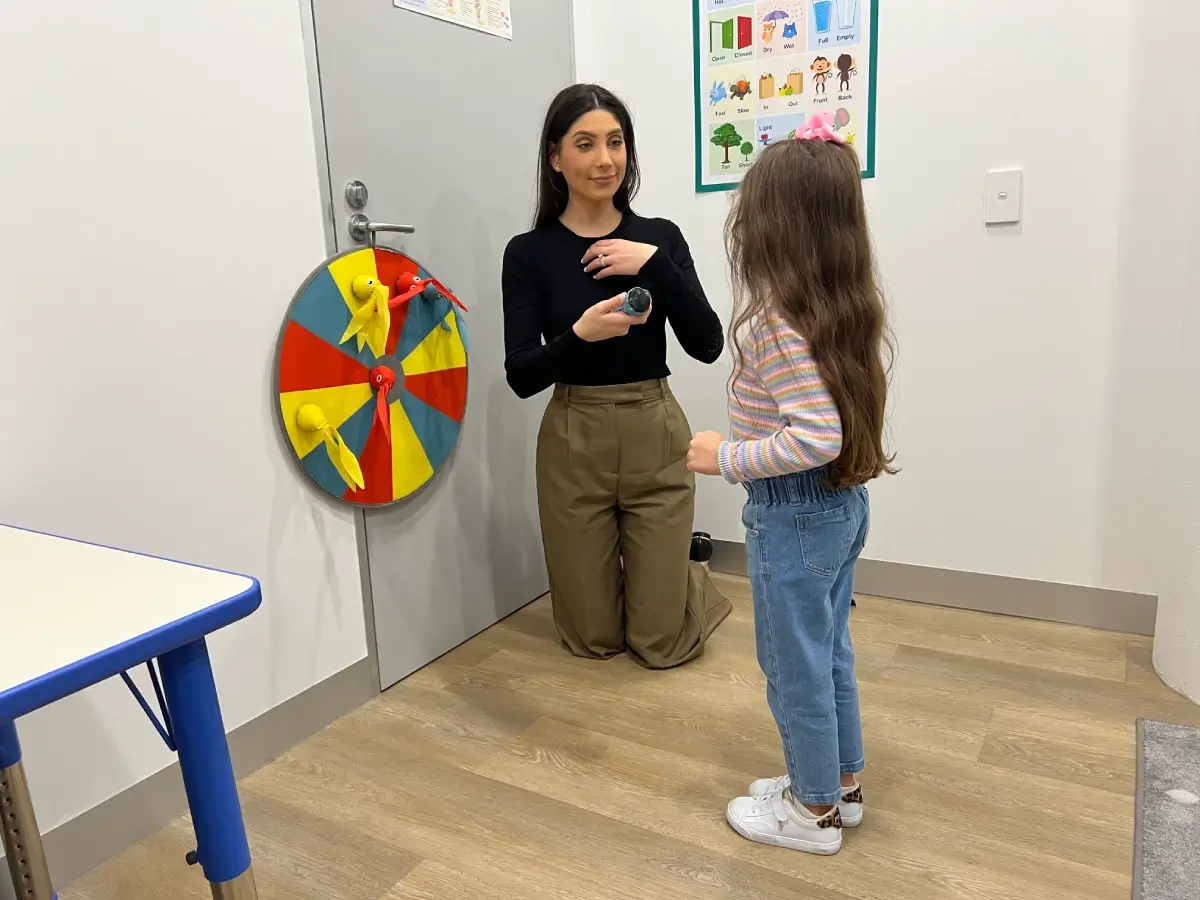
Your six year old follows every instruction you give. They laugh in the right place in a story, find the shoes you asked for, and clearly know exactly what is going on around them. What they do not do is talk much. If that sounds familiar, you are not imagining the gap, and you are not being an anxious parent for noticing it.
A child who understands well but says very little is one of the most common presentations we see at our Balmain clinic. It is also one of the most misread, because strong understanding tends to reassure everyone around the child that things will sort themselves out.
Understanding and talking are two separate skills
Receptive language is what your child takes in. Expressive language is what they can send back out. These two skills sit on different tracks, and receptive language almost always runs ahead of expressive language in typical development. A child can comprehend a full classroom instruction and still find it very hard to retrieve the right word, build a sentence around it, or hold a story together from beginning to end.
So a strong understanding is genuinely good news. It tells us that hearing, attention and comprehension are doing their job, and it usually means there is a solid foundation to build the talking on top of. In our assessments, understanding and using language are scored as separate areas for exactly this reason, and it is very normal to see one sitting well above the other.
Why six is a different conversation to two
At two, “wait and see” is a defensible position for many children. At six it is a much harder one to justify.
By Kindergarten and Year 1, talking has stopped being purely social. It is how your child answers in class, joins a group task, negotiates a game in the playground and shows a teacher what they know. Spoken language is also the base that reading and spelling are built on, so a child who cannot organise words out loud will often start to wobble on written work in the year or two that follow.
The children we worry about least are the ones whose spoken language is slowly climbing. The ones we want to see are the children whose talking has plateaued while everything around them keeps moving.

What can sit behind this pattern
There is no single explanation, and the right support depends entirely on which of these is in play.
- Developmental Language Disorder (DLD). When an expressive gap persists into the school years without another condition explaining it, this is often the label. Children with DLD understand far more than they can say, and the difficulty is with the language system itself.
- Word finding and sentence building. Some children have plenty to say but cannot pull the words out fast enough, so they abandon sentences, use vague words like “thing” or “stuff”, or simply stop talking rather than get it wrong.
- Speech sound difficulties. If a child is hard to understand, they often talk less. Persistent sound errors at six, or the choppy, inconsistent speech pattern seen in Childhood Apraxia of Speech, can shrink a child’s willingness to speak at all.
- Hearing. Fluctuating hearing loss from middle ear fluid can be intermittent enough that a child still follows familiar routines while missing a great deal of new language.
- Selective mutism. This one matters at six. If your child talks freely at home and goes silent at school, you are likely looking at anxiety rather than a language difficulty, and it responds to a very different approach.
- Autism. Some autistic children understand well and communicate less through speech. This is a difference in how communication works rather than a deficit to be corrected, and support is built around the child’s own communication.
What an assessment actually looks at
A speech pathology assessment at this age is not one test. We look at receptive language and expressive language separately, check speech sound production, listen to how your child tells a story or explains something that happened, and watch how they use language socially with an unfamiliar adult.
We also want to know what school is seeing, because the gap between home and classroom is often the most useful piece of information there is. A child who talks in full sentences to a parent and answers in single words to a teacher is telling us something specific.
The outcome is a picture of which skills are solid, which are lagging, and what is realistically getting in the way of your child talking more.
Things that help at home
- Comment more, question less. Six year olds with expressive difficulties often face a wall of questions all day. Narrating what you are doing gives them language without demanding a performance.
- Leave the pause longer than feels comfortable. Word finding takes time. Counting silently to five before you jump in gives your child room to land the sentence themselves.
- Offer the words out loud. “Do you want the blue one or the green one?” gives your child a model to borrow, which is easier than generating a phrase from scratch.
- Recast rather than correct. If they say “him goed park”, you say “yes, he went to the park”. They hear the correct form without being pulled up on it.
- Protect low-pressure talking time. Cooking, driving and building things side by side produce more spontaneous language than sitting face to face.

When to book an assessment
If your six year old understands everything and still is not talking in full, clear sentences, it is worth having it looked at properly rather than waiting another school term. Early support at this age is about protecting confidence and literacy as much as speech itself.
Our speech pathologists work with children aged 0 to 16 across Balmain and the Inner West, and we accept NDIS, Medicare and private health rebates. Get in touch with our team to book an assessment or simply talk through what you are noticing.