Your four year old talks. That is usually the first thing parents tell us. They have words, plenty of them, and they use them all day. What they do not do is string those words into proper sentences. You get “want juice” and “go park now” and “Daddy car”, and the rest you fill in yourself.
It is a specific worry and it does not fit neatly into the milestone checklists online, which tend to cover children who are barely speaking at all. So here is what four should sound like, and what it usually means when sentences have not arrived.
What sentences usually look like at four
By four, most children are putting together sentences of four to five words or more, and those sentences are starting to carry grammar. Plurals turn up, past tense appears even if it comes out as “goed” and “runned”, and pronouns like he, she and they get used mostly correctly.
Four year olds also begin joining ideas together with linking words. “I want the blue one because it is fast.” “We went to Nanna’s and then we had ice cream.” That linking is a genuine leap, because it means the child is holding two ideas in mind and connecting them out loud.
They should also be answering who, what and where questions, retelling a simple thing that happened at preschool, and being understood by adults outside the family most of the time.
Not every child hits all of this at once. Ranges are wide and no clinician panics over a single item. What we look at is the overall shape.
Sentence building is its own skill
Parents often assume that if vocabulary is good, sentences will follow. They usually do, but not always, because the two are not the same skill.
Vocabulary is storage. Sentence building is assembly, and it needs word order, grammar markers, and enough working memory to hold the whole thing together while it comes out of the mouth. A child can have hundreds of words available and still lose the structure halfway through, so they solve the problem by keeping utterances short.
In our clinic we count average sentence length across a play sample rather than relying on a single example, because a child who produces one impressive sentence on a good day may be sitting at two or three words the rest of the time. When we run speech therapy for toddlers and preschoolers at this age, growing sentence length and grammar is one of the most common goals we work on.

What can sit behind short sentences at four
- Expressive language delay. Understanding is fine, vocabulary is fine, and the difficulty sits in producing longer, well-formed utterances. This is the most common picture we see at four.
- Developmental Language Disorder. When the difficulty is persistent and there is no other condition explaining it, DLD is often the outcome. Grammar errors that stick around, short sentences and word-finding trouble are typical.
- Speech clarity getting in the way. If a child is hard to understand, longer sentences bring more risk of not being understood. Some children shorten their speech to protect themselves from that.
- Hearing. Repeated middle ear fluid can make a child miss the quiet grammatical bits of speech, the endings and small words that sentences are built from.
- Autism or developmental differences. Language may develop along a different path, sometimes with scripted phrases sitting alongside very short spontaneous utterances.
- Growing up with more than one language. This does not cause delay. Children learning two languages should be assessed across both, because looking at only one gives a misleading picture.
What an assessment actually looks at
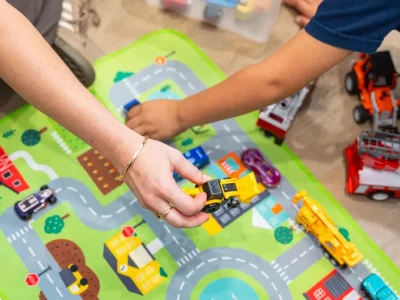
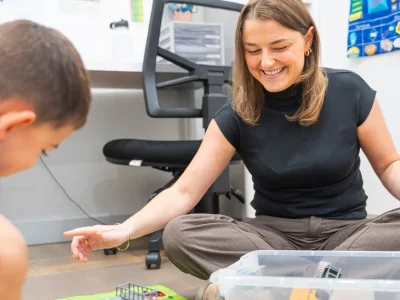
An assessment at four is mostly play and conversation, not testing at a desk.
We take a language sample while your child plays, then look at how long their sentences run, what grammar is present and what is missing, and whether they can sequence a simple story. We check understanding separately, because a gap between the two changes the plan. Speech sounds get looked at as well, since clarity and sentence length often influence each other.
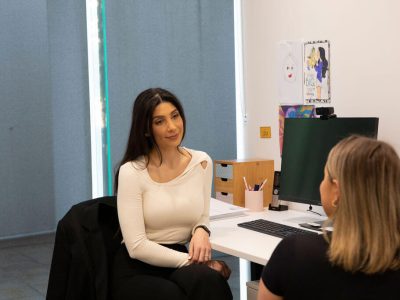
We also ask what preschool is seeing, and we will usually recommend a hearing check with an audiologist if there has not been a recent one.
You come away with a clear picture of which skills are solid, which are behind, and what we would work on first.
Things that help at home
- Add one word to what they say. If your child says “big truck”, you say “a big red truck”. Staying just above their current level is far more useful than modelling a sentence they cannot yet copy.
- Recast instead of correcting. “Him goed to school” becomes “yes, he went to school” in your reply. Your child hears the right version without being pulled up.
- Comment more than you question. A day full of questions puts a four year old under performance pressure. Narrating what you are doing gives them language with nothing owed back.
- Talk about what already happened. Retelling the morning at drop-off or what happened at the park pushes sentences to get longer, because the listener cannot see what the child is describing.
- Read the same books repeatedly. Familiar stories let a child predict the next line and join in with longer stretches of language than they would produce on their own.
Why four is the age to act
Three is often a reasonable point to watch and support. Four is different, because the year before school is when spoken language becomes the base for reading, writing and classroom learning.
Children who start Kindergarten with short, simple sentences tend to find written work harder later, and the gap does not usually close on its own once school begins. Waiting one more term is the option most parents want, and it is the one we most often wish families had skipped.
If you are unsure, an assessment is a low-stakes way to find out. Either your child is developing along their own timeline and you get reassurance, or there is something to work on and you have started early.
Our speech pathologists work with children aged 0 to 16 across Balmain and the Inner West, in clinic or by telehealth, and we accept NDIS, Medicare and private health rebates. Get in touch with our team to book an assessment or to talk through what you have been hearing at home.