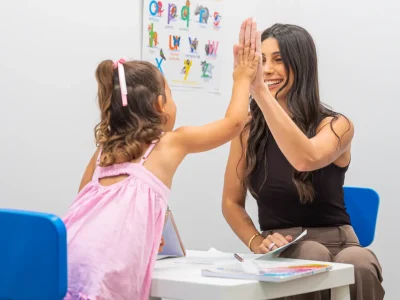
You are at the playground and you hear another three year old chatting away in full sentences. Then you glance at your own child, who is happily playing but saying very little. It is one of the most common worries parents bring to us in Balmain and across the Inner West, and it is a fair one to have.
The short answer is yes. Three year olds should be talking, and by this age most are talking a great deal. What matters more than an exact word count is whether your child is using language to connect with the people around them, and whether those people can understand what is being said.
What talking usually looks like at three
By their third birthday, most children are putting together sentences of three, four or more words. They ask questions, and plenty of them. They can name familiar people and objects, tell you about something that happened earlier in the day, and hold a short back and forth conversation about a topic they care about.
You will also start to hear grammar arriving. Plurals turn up, past tense verbs turn up, and so do the wonderful overcorrections that come with them, like “eated” and “goed”. In our sessions we treat those errors as a good sign rather than a problem. A child who says “runned” has worked out a rule and is applying it everywhere, which is exactly what should be happening at this stage.
Understanding matters just as much as talking. A three year old can usually follow a two part instruction such as “get your shoes and put them by the door”, answer who and where questions, and understand far more words than they can actually say.
How clear should a three year old sound?
This is where many parents get caught out. Saying plenty of words is not the same as being understood.
At three, a parent should understand most of what their child says. Someone less familiar, like a new educator at preschool or a relative your child sees a few times a year, should be able to follow a decent share of it too. If you find yourself translating for your child throughout the day, or your child gives up when people do not catch what was said, that is worth attention.
Some sound errors are perfectly normal at this age. Trickier sounds like r, th, l and s blends often take longer to settle, and children commonly simplify longer words, so “elephant” might come out as “efant”. Early sounds such as p, b, m, w, t, d and n should be reasonably reliable by now. When those early sounds are still missing or being swapped, or the vowels sound unusual, we would rather see a child sooner than later.
When it is worth booking an assessment
Trusting your instincts is reasonable, and so is checking. These are the patterns we would encourage you to act on rather than wait out:
- Using single words or very short phrases instead of sentences
- Family members and educators regularly cannot understand what your child says
- Avoiding talking, showing frustration, or leading you by the hand instead of asking
- Very little back and forth in conversation, even about favourite topics
- Words that were once there and then disappeared
- Instructions that need constant repeating, or only ever get half followed
Parents are often told to wait and see whether a child catches up on their own. Some children do. The difficulty is that there is no reliable way to pick which ones will, and the preschool years are when language grows fastest.
This is why we start speech therapy for toddlers and preschoolers early wherever we can, because the years before school are when new skills stick most easily and when a small amount of support goes a long way. An assessment is not a commitment to therapy either. Plenty of families leave a first appointment with reassurance and a few ideas to use at home.
What a speech pathology assessment involves
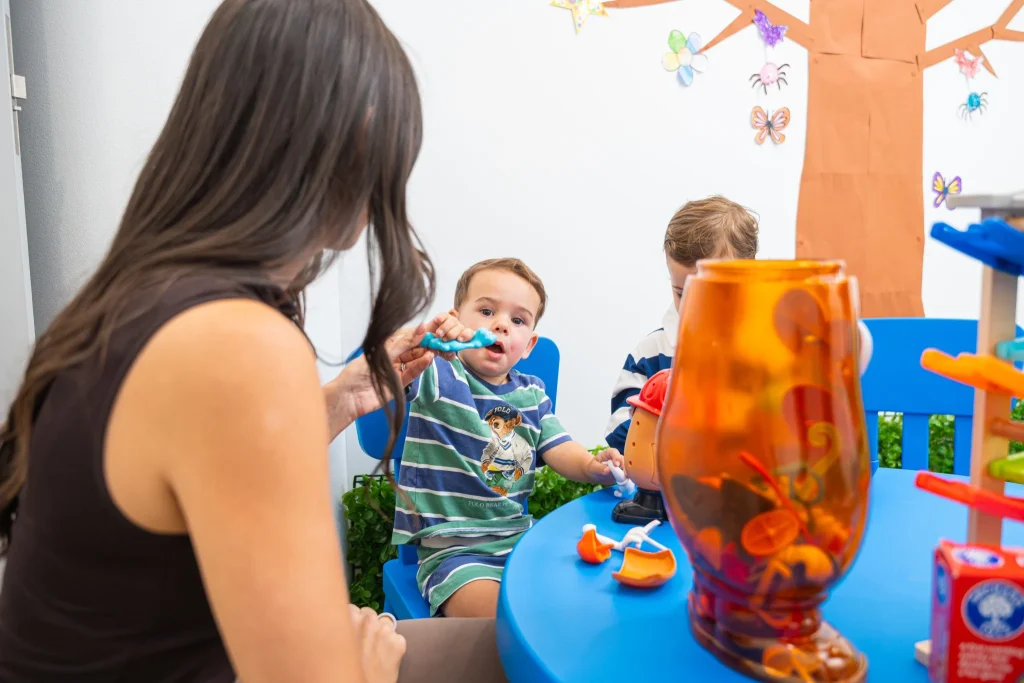
It is far less formal than most parents expect. We spend time playing with your child and watching how they communicate, not just what they say. We listen for the sounds they can produce, the length and structure of their sentences, how much they understand, and how they use language socially.
We also spend a good chunk of the appointment listening to you. Parents notice things that never show up in a clinic room, like which words are used at home, what your child was doing at eighteen months, or whether there is a family history of late talking or ear infections.
Recurrent ear infections and glue ear are worth mentioning, because fluctuating hearing during the toddler years can affect how speech sounds develop. If hearing has not been checked recently, we will usually suggest that alongside the assessment.

Simple things that help at home
The strategies we teach parents are ordinary and repeatable, which is what makes them work:
- Get face to face and at your child’s level so they can watch your mouth
- Add a word or two to whatever they say. If they say “big truck”, you say “yes, a big red truck”
- Pause and wait after you ask something. Three or four seconds feels long, and it gives a child the space to have a go
- Comment more than you question. A running commentary during bath time or snack time offers more language than a quiz does
- Model the correct version rather than correcting. If your child says “tat”, you reply “yes, a cat” and carry on
- Read the same books over and over, since repetition is how new words settle in
Screen time is worth a mention here too. Language is learned through interaction, so a child who watches a program with you and talks about it is getting far more from it than a child watching alone.
Getting support in Sydney's Inner West
If you have read this far, chances are something has been sitting at the back of your mind for a while. That instinct is worth acting on, and you do not need a referral to see a speech pathologist privately in Australia.
Depending on your situation, NDIS funding, a Medicare Chronic Disease Management plan through your GP, or private health cover may help with the cost.
Our Child Speech pathologists at Kids and Cubs Clinic works with children from birth to sixteen years, with sessions available at our Balmain clinic or by telehealth.
Contact us to talk through what you have noticed and book an assessment. A short conversation now is far easier than another year of wondering.